


19 Jul TPO vs. TPE: What’s the Real Difference for Flexible Sheet Applications?
TPO vs. TPE: What’s the Real Difference for Flexible Sheet Applications?
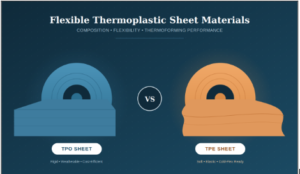
If you’ve ever specified a flexible thermoplastic sheet for an automotive interior, a medical device housing, or a protective liner, you’ve probably run into two acronyms that get tossed around almost interchangeably: TPO and TPE. They sound alike, they show up in the same product category, and vendor spec sheets don’t always spell out the distinction. But treating these materials as identical can lead to expensive surprises, parts that crack in cold storage, sheets that won’t bond the way you expected, or a thermoforming run that fights you every step of the way.
Understanding the real difference between TPO sheet material and thermoplastic elastomer properties in general is the first step toward choosing the right material for your part, your tooling, and your budget. This guide breaks down TPO vs TPE for thermoforming, where each one performs best, and how to make a confident sourcing decision.
What Are TPO and TPE Materials, Exactly?
Here’s where a lot of the confusion starts: TPE isn’t a single material. It’s a broad family of polymers that behave like rubber but process like plastic. Within that family sit several distinct chemistries, thermoplastic polyolefins (TPO), thermoplastic vulcanizates (TPV), thermoplastic polyurethanes (TPU), and styrenic block copolymers (SBS/SEBS), among others.
In other words, TPO is a type of TPE, not a competing category. Asking “TPO or TPE” is a bit like asking “sedan or car”, the comparison only makes sense when you’re really asking how TPO stacks up against the other elastomer chemistries, particularly the softer, rubber-like formulations people usually picture when they hear the word TPE. That’s the comparison this guide focuses on.
TPO Sheet Material: Composition and Properties
TPO sheet material is built from a blend of polypropylene and an elastomeric component typically ethylene-propylene rubber (EPDM) combined without chemical crosslinking. That blend gives TPO a useful middle ground: it’s tougher and more rigid than a true rubber, but far more impact-resistant and weatherable than standard polypropylene alone.
Key characteristics of TPO sheet material include:
- Excellent UV and weather resistance, which is why it’s a staple in roofing membranes and exterior automotive trim
- Good chemical and stain resistance, useful in industrial liners and outdoor applications
- Low density and lighter weight compared to many rubber alternatives, which helps with shipping and part weight
- Strong dimensional stability across a range of temperatures
- Recyclability, since TPO is not chemically crosslinked like traditional rubber or TPV
Where TPO tends to fall short is surface softness and elongation. It has a firmer hand-feel and lower stretch than softer TPE formulations, which matters for applications where a cushioned or rubbery touch is part of the spec.
Thermoplastic Elastomer Properties: What Sets Softer TPE Apart
When people ask about thermoplastic elastomer properties in a general sense, they’re usually describing the softer end of the TPE spectrum SEBS-based compounds, TPU, or TPV. These materials are formulated to mimic rubber more closely, with a few defining traits:
- High elongation and elastic recovery, meaning the sheet stretches significantly and returns to its original shape
- Softer surface hardness, often specified on the Shore A scale rather than Shore D, giving a rubbery, grippable feel
- Strong low-temperature flexibility, which makes many TPE grades a better fit for cold-climate seals and flexible packaging
- Wide compatibility for overmolding, since many TPE grades bond well to rigid substrates like polypropylene or ABS
- Clarity options, with some TPE formulations available in translucent or clear grades something TPO generally cannot match
The trade-off is cost and, in some formulations, weathering performance. Certain TPE chemistries are more expensive per pound than TPO and may require UV stabilizers to match TPO’s outdoor durability.
TPO vs TPE for Thermoforming: Key Differences
Thermoforming performance depends on how a sheet heats, sags, stretches, and cools in the mold, and this is where TPO and softer TPE grades diverge most in practice. TPO generally offers a more forgiving, predictable thermoforming window with less draw-related thinning, while softer TPE grades demand tighter control over heating uniformity because of their higher elongation.
| Property | TPO Sheet Material | Softer TPE (TPV/SEBS/TPU) |
|---|---|---|
| Surface feel | Firmer, plastic-like | Soft, rubbery |
| Typical hardness range | Shore D 40–65 | Shore A 30–90 |
| UV / weather resistance | Excellent | Good to excellent, formulation-dependent |
| Elongation at break | Moderate | High |
| Cold-temperature flexibility | Good | Very good to excellent |
| Recyclability | High (non-crosslinked) | Varies by chemistry |
| Relative material cost | Lower | Moderate to higher |
| Thermoforming draw depth | Good, predictable | Excellent, but needs tighter heat control |
| Best surface texture range | Matte, grained finishes | Soft-touch, grip-focused finishes |
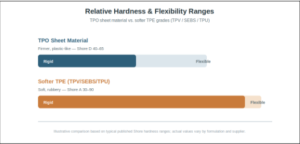
Neither material is universally “better” , the right choice depends entirely on what the part needs to do once it leaves the mold.
Where Each Material Performs Best
Automotive Interiors and Exteriors
TPO sheet material dominates exterior trim, wheel arch liners, and bumper fascias because of its UV stability and impact resistance. Softer TPE grades, on the other hand, show up more often in interior soft-touch panels, armrests, and grip surfaces where a cushioned feel improves perceived quality.
Medical and Healthcare Applications
TPE’s flexibility, clarity options, and biocompatible formulations make it a common choice for tubing, seals, and flexible housings. TPO can still play a role in rigid enclosures or covers where chemical resistance and cost matter more than softness.
Industrial and Protective Packaging
For liners, gaskets, and protective sheeting exposed to weather or outdoor storage, TPO’s durability and lower cost per square foot often make it the more practical flexible thermoplastic sheet option. TPE tends to get specified when the packaging needs to cushion, seal tightly, or flex repeatedly without fatigue.
Processing Considerations for Thermoforming
Sheet gauge, heating profile, and mold design all shift depending on which material you’re running. TPO typically thermoforms well across a wider processing window, which reduces scrap rates for teams still refining their setup. Softer TPE sheet requires more careful attention to:
- Heating uniformity – uneven heat can cause localized thinning in high-elongation TPE grades
- Mold release – softer, tackier TPE surfaces may need adjusted release agents or textured tooling
- Cooling time – higher elongation materials often need longer cycle times to set dimensionally
- Trim tooling wear – softer materials can be gentler on trim dies but may require sharper blades to avoid tearing
Working with a supplier who understands both chemistries, and can advise on gauge and formulation before tooling is cut saves significant rework time later in the program.

Common Mistakes When Choosing Between TPO and TPE
- Assuming “TPE” on a spec sheet always means soft and rubbery. Since TPO is technically a TPE, generic references can be misleading always confirm the specific chemistry.
- Prioritizing cost over end-use performance. A cheaper TPO sheet that cracks in cold storage costs more in returns than a properly specified TPE grade.
- Overlooking bonding and overmolding compatibility. Not all TPE grades adhere the same way to rigid substrates; adhesion testing should happen before full production.
- Skipping a thermoforming trial run. Draw ratios and forming temperatures that work for TPO rarely transfer directly to a softer TPE without adjustment.
Key Takeaways
- TPO is a specific type of thermoplastic elastomer, not a separate category from TPE.
- TPO sheet material offers strong UV resistance, dimensional stability, and recyclability at a lower relative cost.
- Softer TPE grades (TPV, SEBS, TPU) deliver higher elongation, a rubbery feel, and better cold-flex performance, often at a higher cost.
- For TPO vs TPE for thermoforming, TPO generally offers a wider, more forgiving processing window.
- The right flexible thermoplastic sheet depends on the application’s softness, weathering, bonding, and budget requirements not on which material is “newer” or “better” in general.
Conclusion
TPO and TPE aren’t rival materials they’re related chemistries built for different jobs. TPO sheet material earns its place in applications that demand weatherability, dimensional stability, and cost efficiency, while softer TPE formulations take over where flexibility, cushioning, and cold-temperature performance matter most. The real work isn’t picking a “winner” between TPO vs TPE for thermoforming; it’s matching the specific properties your part needs to the chemistry built to deliver them.
If you’re weighing a flexible thermoplastic sheet for an upcoming program, talk to your material supplier early, before tooling is finalized. A short conversation about hardness range, bonding requirements, and thermoforming tolerances can save weeks of rework later. Reach out to discuss sample sheets and processing guidance for your next project.
Frequently Asked Questions
Is TPO the same as TPE?
No. TPE is a broad category of rubber-like plastics, and TPO is one specific chemistry within that category. When people compare “TPO vs TPE,” they’re usually comparing TPO to softer TPE formulations like TPV or SEBS.
Which is more flexible, TPO or TPE?
Softer TPE grades generally offer higher elongation and a more rubbery feel than TPO. TPO is more rigid and plastic-like, though still more flexible than standard polypropylene sheet.
Is TPO sheet material recyclable?
Yes. Because TPO is not chemically crosslinked, it can typically be reprocessed and recycled more easily than crosslinked rubber or TPV materials.
Which material thermoforms better?
TPO usually offers a more forgiving thermoforming window with fewer draw-related defects. Softer TPE can thermoform successfully but often needs tighter control over heating and cooling.
Is TPE more expensive than TPO?
In most cases, yes. Softer TPE formulations tend to cost more per pound than TPO, though the difference varies by supplier, gauge, and specific chemistry.
Can TPO and TPE be bonded or laminated together?
In some cases, yes, particularly when compatible tie layers or co-extrusion processes are used. Compatibility should always be confirmed with your material supplier before committing to a design.